1. Start with the bar model
Cutter bar parts differ from one manufacturer to another and even between models from the same manufacturer. Before looking for any code, note:
- the make and model of the motor mower, mower or combine (for example BCS, Bertolini, Barbieri, Gaspardo, Gribaldi & Salvia, Busatis);
- the bar model, if marked (for example BCS Europa, Laser or Duplex, Bertolini Pratolina);
- the working width of the bar.
2. Find the parts diagram
A parts diagram is an exploded view of the bar: the components are drawn separately, in assembly order, and each one has a position number. We use the diagrams from the official RIMA catalogue No. 13: 32 diagrams covering BCS, Bertolini, Barbieri, Bedogni-Olimpia, Nibbi-Figaro, Valpadana-SEP, Gaspardo, Gribaldi & Salvia and Busatis bars, plus the cutter bar of the Arbos combine. You will find them on the RIMA Parts page, and each part’s page also shows the diagrams in which it is used.
For some bars (for example Grillo, Casorzo, Fort, Aebi or Agria), the RIMA catalogue has no parts diagram. In that case the part is identified by its code or from photos and measurements.
3. Read the position and the variants
In the diagram’s table, each position has one or more codes. The letter after the number marks variants for the same place on the bar: on the Barbieri bar diagram, for example, positions 01A, 01B and 01C are three different serrated knife sections, and 02A and 02B are two different double guards (Mulching and semi-fine). Variants may be the original or the RIMA code, fine or semi-fine guards, or different lengths, so choose the one that matches your bar exactly.
4. Original code and RIMA code
For each part, the catalogue gives two codes: the original code of the bar manufacturer (for example 20207/1) and the RIMA code, in the form RM03-012. On our website, parts are listed under the original code, or under the RIMA code where there is no original code. You can send us either.
The same original code can appear in several diagrams, at different positions. The Mulching knife hold-down clip with code 20863, for example, appears at position 03A on the Bertolini Pratolina and at position 03 on the Casorzo and Grillo, and it has three RIMA codes (RM07-100, RM09-037, RM18-063). That is why you should always start from your own bar’s diagram: it shows the correct code for that particular position.
5. Knives, sections, guards and plates
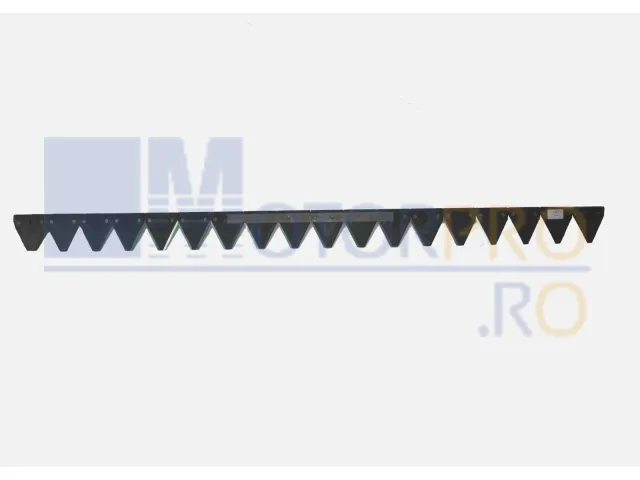
- Knives are identified by the number of sections and the section type, for example “19-section knife 2466 SF” or “25-section knife D2001R”. Count the sections on the old knife and check their type: the same bar may take knives of different lengths.
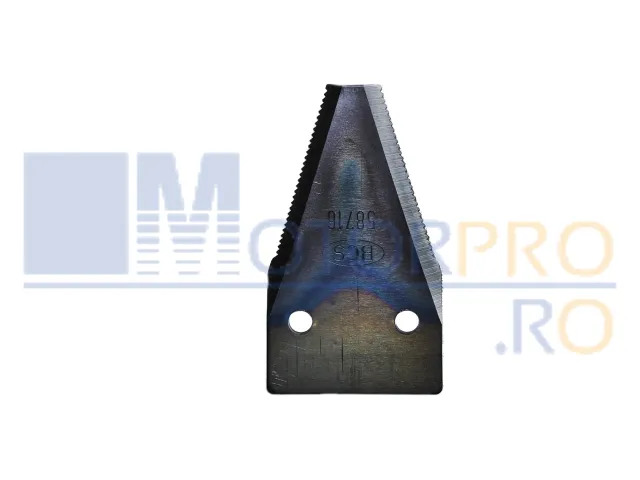
- Knife sections can be replaced individually, by riveting, when broken or worn. Check the profile (serrated, with heel) and the matching rivets, for example 6 × 16 TT or 6.5 × 16 TC.
- Knife back bars (consumable or perforated) are the backing onto which the sections are riveted, and they are also chosen by the number of sections, for example a perforated back bar for 21 or 27 sections.
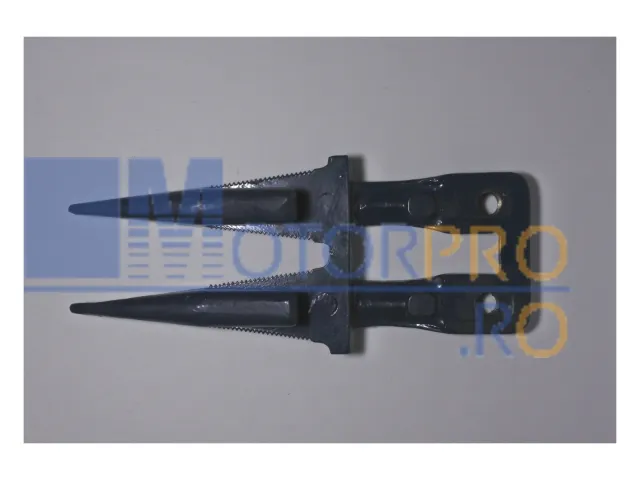
- Guards (single or double) differ by type (for example fine, semi-fine, narrow or Mulching) and by bar.
- Hold-down clips and guides keep the knife in position on the guards; this group also includes the knife cleaning plates and the knife head, which connects the knife to the drive mechanism.
6. Pack quantity
The packaging column in the RIMA catalogue shows how many pieces are in a pack, not how many are fitted on the bar. 2466 sections, for example, come in packs of 25, and perforated back bars in packs of 5. Work out the number of pieces you need by counting the parts on your own bar.
Not sure which part you need? Send us the make and model of the bar, the code on the old part (original or RIMA) and its position in the parts diagram or, if you do not have these, a few photos of the part and the bar, together with the number of sections and the knife length. We will reply with the correct code.