Scrubbing or sweeping
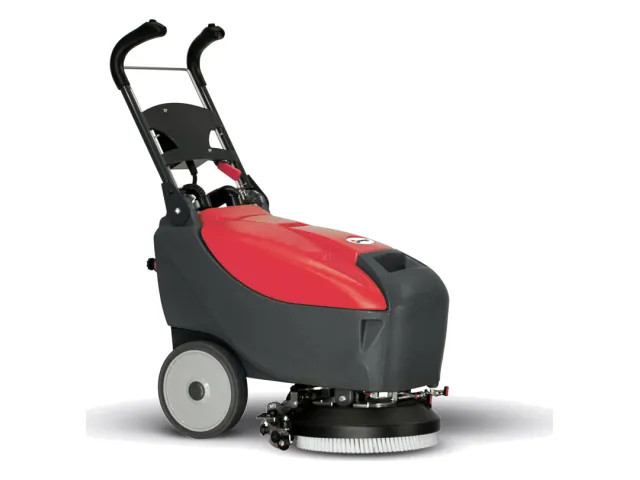
Floor scrubbers (scrubber-dryers) put down cleaning solution, scrub the floor with the brush and pick up the dirty water through the squeegee. After a single pass the floor is clean and dry. They work on hard floors: tiles, power-floated concrete, resin, PVC.
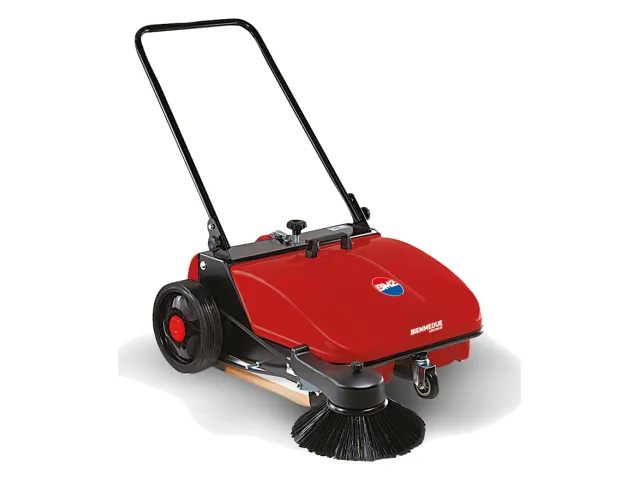
Sweepers pick up dust, sand and solid debris without water. You use them in warehouses, yards, car parks and production halls where a lot of dust or coarse debris builds up. Many halls use both: sweep first, then scrub.
Walk-behind or ride-on
Walk-behind models are compact and fit easily between shelves and tables or along narrow aisles. In the Biemmedue WET range: WET 350 (350 mm working width, 16/18 l tanks), WET 450 (450 mm, 40/45 l) and WET 550 BA (550 mm, two brushes and a traction motor).
Ride-on models (WET 560 BA, WET 850 BA, WET 1000 BA) have large tanks, from 75/80 l up to 145/160 l. They are for large areas where the operator works for hours at a stretch: supermarkets, logistics centres, industrial halls.
Working width and how many m² you cover per hour
The m²/h figure on the datasheet is theoretical: working width multiplied by forward speed, with no stops at all. In the WET range it rises from 1,050 m²/h (WET 350) to 1,800 m²/h (WET 450), 2,750 m²/h (WET 550 BA), 3,000 m²/h (WET 560 BA), 5,100 m²/h (WET 850 BA) and 6,000 m²/h (WET 1000 BA). In real use, manoeuvring, corners, emptying the recovery tank and refilling with solution bring that figure down a lot, so leave yourself a margin.
The sum is simple: divide the area to be cleaned by the time you have. If you need to do 2,000 m² in one hour a day, a machine rated at a theoretical 1,800 m²/h will not keep up in practice. A model rated at 3,000 m²/h or more gives you the margin you need. Measure the aisles as well, because a wide machine is no help if it cannot fit between the racks.
Battery or mains
Mains-powered (EL) models such as the WET 350 EL and WET 450 EL have unlimited run time and need no batteries. On the other hand, the cable limits how far you can work and has to be watched where people or goods are moving. They suit small and medium areas with sockets close at hand.
Battery-powered (BA) models work without a cable. Stated run time varies from model to model: 1 h 20 min on the WET 350 BA (AGM battery included), 1 h 45 min – 2 h 45 min on the WET 450 BA and WET 550 BA, over 3 h on the WET 560 BA and 4 h 45 min on the WET 850 BA and WET 1000 BA. On the other BA models the batteries are not included. The capacity you choose (for example 2 × 12 V / 86 Ah or 2 × 12 V / 140 Ah GEL on the WET 450 BA) has a direct effect on run time, so it is worth deciding it with us.
Sweepers
The Biemmedue range starts with the Dusty 650M, pushed by hand (650 mm, 1,500 m²/h). Next come the self-propelled models, battery-powered (ET) or with a Honda petrol engine (STH), in 650 and 850 mm widths (2,500–3,500 m²/h), and the largest is the ride-on Dusty 1100, with a 1,100 mm working width and 5,000 m²/h. The ONE series, with a cartridge filter, is designed for heavy industrial work. Petrol versions are used mostly outdoors, battery versions indoors.
Single-disc machines and steam cleaners
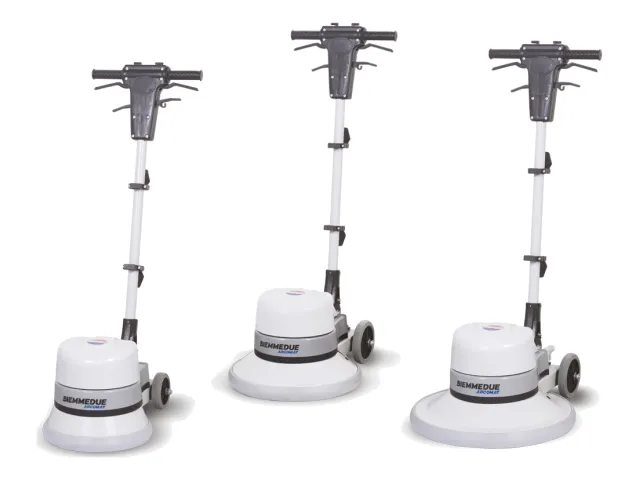
Single-disc machines MS 13, MS 17 and MS 20 (330, 430 and 505 mm working widths, single-phase supply) do not pick up water. By changing the brush or pad, the same machine scrubs, polishes and waxes hard floors and carpets. They are useful for periodic treatments and in smaller spaces.
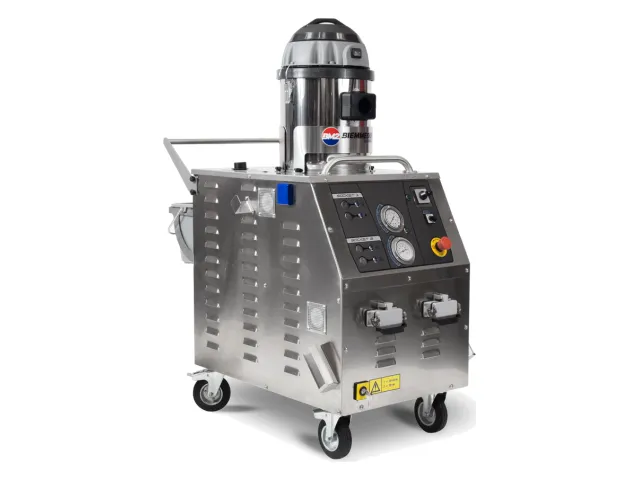
Steam cleaners (10 bar and 190 °C on most models) are for spot sanitising: grout lines, professional kitchens, food areas, washrooms. On large areas they do not replace a floor scrubber.
Send us the floor area, the type of floor, the aisle width and how much time you have for cleaning each day, and we will recommend the model and the batteries.